Shrimp Industry in India
The Escape We Don’t See: Brazil’s Prawn Warning and India’s Vannamei Future
Most escapes begin quietly: a few animals leaving through drainage, a few more during floods, some carried by harvest water, some released from culture systems into nearby canals.
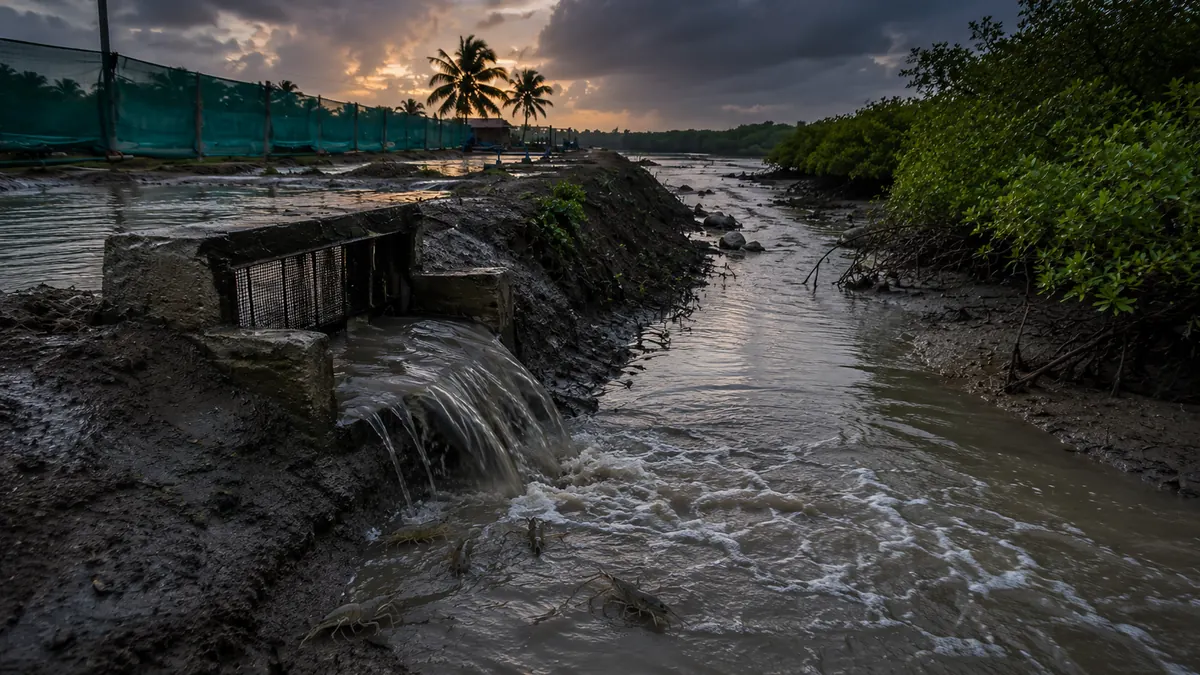
A Small Leak Can Become a Wild Story
Most escapes begin quietly: a few animals leaving through drainage, a few more during floods, some carried by harvest water, some released from culture systems into nearby canals.
Brazil’s story with the giant freshwater prawn, Macrobrachium rosenbergii, is a reminder of this. The species is native to Asia, but it was introduced into Brazil in 1977 for aquaculture trials. Decades later, researchers have recorded it from multiple Brazilian drainage basins and estuarine systems, including protected coastal areas. A 2026 study reported persistent records between 2015 and 2025 and egg-bearing females in the Cananéia estuarine–lagoon complex, suggesting local reproduction and possible establishment.
This is the uncomfortable lesson: an introduced aquatic animal may remain invisible in nature for years. By the time people start noticing it in catches, the escape may no longer be a single event. It may already be a pattern.
What Brazil Teaches Us
We must be careful: available studies do not prove one exact escape route or name one hatchery or farm as the source. The broader lesson is that aquaculture with non-native species can become a pathway into rivers and estuaries, especially when animals are repeatedly produced near suitable natural habitats. The Brazil paper links many records with aquaculture areas and calls for stronger monitoring, licensing review, native-species studies, genetic studies, and pathogen-risk studies.
The likely weak points are familiar: poor outlet screening, untreated discharge, flood overflow, harvest escape, connected canals, live animal transport, weak monitoring, and delayed reporting. Each leak may release only a few animals. But repeated leakage of small numbers of live animals into the same habitat.
The best prevention is to reduce these repeated leaks as much as possible. The fewer live animals reach natural waters, the safer the ecosystem remains.
How Can a Few Escaped Animals Find Each Other?
This is the question many farmers ask. Rivers are huge. Estuaries are wide. If two or three males and females escape, will they ever meet?
The answer is: one tiny escape may fail. Many tiny escapes from the same farming belt over many years are different. Animals may not meet in the middle of a vast river, but they may meet near the same drainage canals, the same creek mouths, the same estuary, or the same protected backwater where culture water repeatedly enters nature.
For M. rosenbergii, this matters because its life cycle uses freshwater and brackish water environments. The 2026 Brazil study reported tolerance across salinity gradients, records from fluvial and marine influenced zones, and egg-bearing females; a direct evidence that reproduction is occurring in at least some invaded areas.
So the lesson is not that one escaped animal changes a river. The lesson is that repeated leakage plus suitable habitat plus time can change the story.
Are Native Species Already Affected?
The honest answer is: the full impact is not completely measured. That itself is a warning. In biological invasions, complete proof often comes late.
For Brazil’s giant prawn case, researchers have raised concerns about competition with native prawns for shelter, food, and space. They also mention possible changes in trophic interactions and sanitary risks, including the possibility of acting as a pathogen reservoir. But exact long term damage to every native species is still not fully quantified.
Even the US Fish and Wildlife Service’s risk screening summary says that M. rosenbergii has been introduced outside its native range due to aquaculture escapes, but also notes that information on impacts is limited and the overall risk assessment remains uncertain.
This is why waiting for “full proof of damage” can be risky. Nature does not wait for our final report.
India’s Vannamei Question
This brings us to a crucial question closer to home. How safe are our own waters here in India?
Litopenaeus vannamei is not native to India. It is native to the tropical eastern Pacific coast of Latin America. India’s large scale commercial culture of vannamei started around 2009, and it has since become a major pillar of the shrimp industry.
India has biosecurity rules. The Coastal Aquaculture Authority requires SPF broodstock cleared through quarantine, prohibits pond reared broodstock, restricts mixing of species in vannamei hatchery premises, and requires hatchery wastewater to be chlorinated and dechlorinated before release, especially to prevent larvae escaping into natural waters.
For farms, the CAA guidelines require biosecurity measures such as fencing, reservoirs, bird-scaring, separate implements, effluent treatment systems, disease reporting rules, wastewater retention, and chlorination/dechlorination during disease related water discharge.
So, the issue is not the absence of rules. The challenge is daily operational implementation on the ground. A rule on paper cannot stop a shrimp if the outlet screen is broken, the bund overtops in flood, harvest water enters a drain untreated, or hatchery discharge carries live larvae.
Is Vannamei Already Outside Farms in India?
A self-sustaining wild population has not been documented anywhere in the country. Therefore, the main objective remains preventative: maintaining strict daily biosecurity controls on the ground to ensure the species stays strictly confined within authorized culture systems.
Escape is already a concern, but an establishment is not proven.
Can Vannamei Breed Outside Indian Farms?
Biologically, vannamei has a marine estuarine life cycle. Adults live and spawn in the open ocean, while post larvae move inshore into estuaries, lagoons, and mangrove areas.
This means small freshwater canals alone are unlikely to support the full life cycle. But coastal creeks, estuaries, lagoons, and marine connected areas are more relevant. Escaped juveniles may survive for some time, and adults may survive if conditions are suitable. For a self-sustaining population, however, many odds must fall in its favour: males and females must survive, mature, mate, spawn under suitable conditions, larvae must survive the planktonic stages, and post larvae must return to suitable nursery areas.
That chain is not easy. This is why many recorded escapes do not become established wild populations. In the United States, USGS reports periodic collections after accidental aquaculture releases, but no evidence of established wild populations. In Thailand, vannamei has been recorded in the wild after aquaculture introduction, but broader Asian reviews still found no confirmed wild establishment outside its native range. Smithsonian’s marine invasions database notes escapes from the US East and Gulf coasts, Hawaii, South America and Thailand, but reports established wild populations only from Venezuela.
So for India, the safest scientific statement is this:
Vannamei escape is possible. Long-term wild establishment in India is not proven, but the danger should not be ignored.
What Could Go Wrong Even Without Establishment?
This is the part many people miss. A non-native shrimp does not need to form a permanent wild population to create risk.
If escaped, vannamei may carry pathogens, increase disease concern, confuse wild catch monitoring, or create local competition for food and space if escapes are frequent. Exotic shrimp viruses associated with L. vannamei may pose risks to native penaeid shrimp fisheries and other crustacean fisheries, while FAO’s Asia-Pacific report warns that transboundary shrimp movements have been linked with serious pathogen concerns such as Taura Syndrome Virus in some countries.
The ecological impact of vannamei outside its native range is still not fully studied. FAO specifically states that broader ecological impacts of alien shrimp introductions in Asia-Pacific have been neither well studied nor well documented, and recommends a precautionary approach.
That is the key message: uncertainty is not safety. Uncertainty is the reason for caution.
The Lesson for India
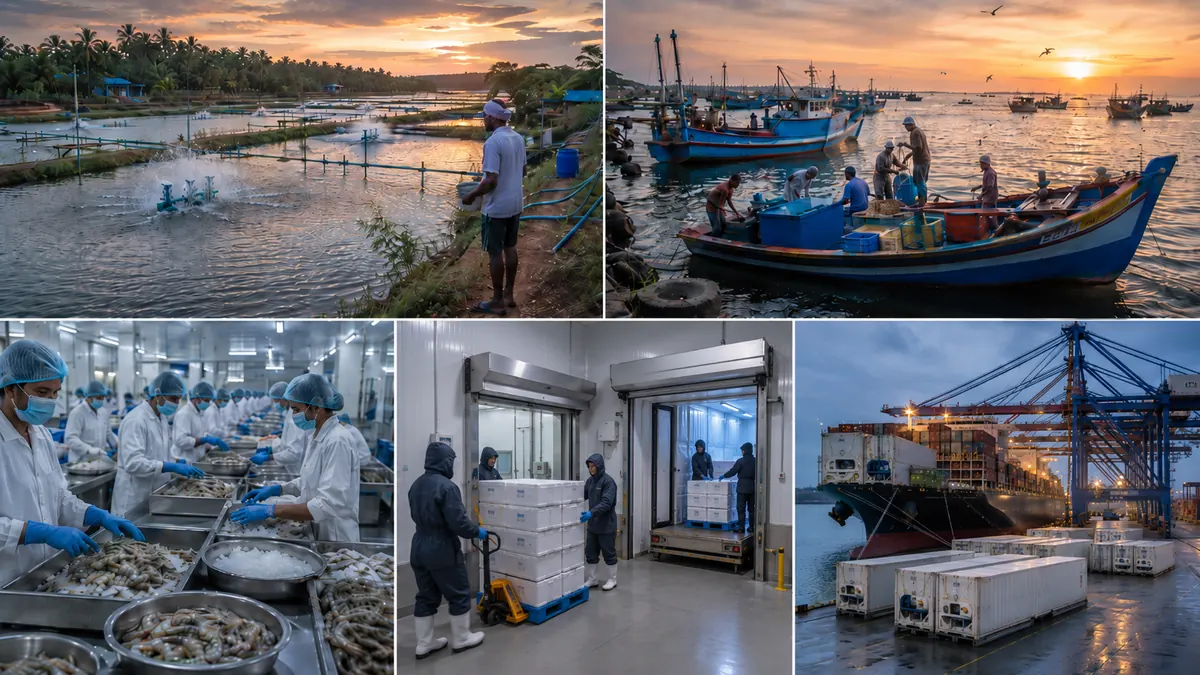
India’s vannamei industry is valuable. It supports hatcheries, farmers, technicians, input suppliers, processors, exporters, workers, and coastal communities. The purpose of this warning is not to attack the industry. The purpose is to protect it.
Biosecurity must be understood in two ways. First, it protects the crop from disease entering the farm. Second, it protects natural waters from farm animals, farm wastewater, and farm-amplified pathogens leaving the system.
That means
- Hatchery effluent must be disinfected properly.
- Post larvae must not escape through wastewater.
- Farm outlets must have working screens.
- Bunds must be strong enough for flood-prone areas.
- Harvest discharge must pass through effluent treatment.
- Diseased ponds must not be drained casually.
- Live rejected stock must not be thrown into canals or creeks.
- Flood-season harvest planning must be taken seriously.
A shrimp farm should produce shrimp. It should not release them.
Final Word
Brazil’s giant prawn story is not a reason to stop aquaculture. It is a reason to respect containment.
A few animals may escape and disappear. Or a few animals may escape again and again, year after year, until nature gives them a chance. That is how some invasion stories begin; not with a bang, but with repetition.
For India, vannamei is too important to be managed carelessly. The economic value is large, but so is the responsibility. The industry needs strong seed, strong disease control, strong wastewater treatment, and strong escape prevention.
The most dangerous sentence is: “Only a few escaped; nothing will happen.”
Maybe nothing will happen. But the history of aquatic invasions teaches us one thing: once a non-native animal learns to live outside our control, the story is no longer written by farmers. It is written by time.
Biosecurity is not only about keeping disease out. It is also about keeping culture animals in.
Community
No approved comments yet. You can start the conversation.